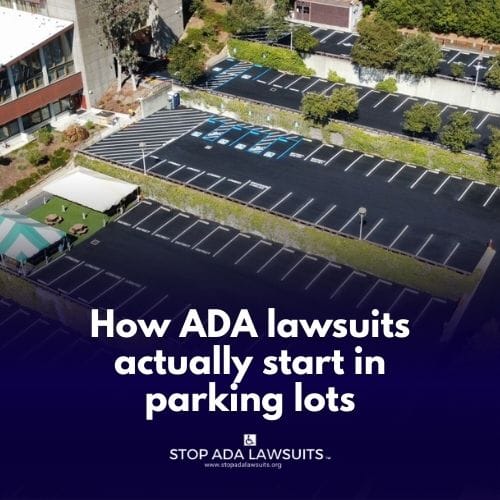
Most ADA lawsuits do not begin with major failures.
They start with small, measurable details in parking lots that quietly drift out of compliance over time.
By the time a property owner becomes aware of the issue, the violation is already documented — and enforceable.
Understanding how ADA lawsuits actually start is the first step to preventing them.
ADA Parking Lot Violations Are Easy to Document
Unlike many other legal claims, ADA violations are not subjective.
They are based on objective measurements, such as:
-
Slopes
-
Dimensions
-
Clearances
-
Surface conditions
-
Visibility of markings
Inspectors and plaintiffs rely on tape measures, digital levels, and photographs — not opinions.
Even small deviations can become valid claims.
Slopes Are the Most Common Trigger
One of the most frequent sources of ADA lawsuits in parking lots is slope noncompliance.
Accessible parking stalls, access aisles, and loading zones must remain within strict slope limits.
In California, slopes may not exceed 2% in any direction.
Over time, asphalt naturally:
-
Settles
-
Compresses
-
Shifts under traffic and weather
As a result, areas that were originally compliant can slowly drift out of tolerance — often without obvious visual warning signs.
🔎 Related resource:
Understanding ADA Slope Requirements in Parking Lots
Pavement Movement Creates Hidden ADA Risk
Asphalt is not static.
Temperature changes, traffic load, and moisture cause pavement to move over time.
This movement can:
-
Alter slopes
-
Create low spots
-
Change transitions between surfaces
-
Disrupt accessible routes
Because these changes are gradual, they are often overlooked until measurements are taken.
🔎 Related resource:
How Pavement Movement Affects ADA Compliance
Surface Conditions Matter as Much as Layout
Accessible routes must be:
-
Firm
-
Stable
-
Slip-resistant
Surface deterioration within accessible areas can trigger violations, even if the layout is technically correct.
Common issues include:
-
Cracks or uneven pavement
-
Poor patch transitions
-
Raveling or surface breakdown
Surface quality is enforceable, not cosmetic.
🔎 Related resource:
ADA Surface Condition Requirements Explained
Striping Is Enforceable, Not Decorative
Faded or incorrect striping is one of the most commonly cited ADA violations.
Accessible stalls, access aisles, and loading zones must be:
-
Clearly visible
-
Properly sized
-
Correctly marked
When striping fades or becomes inconsistent, compliance is lost — regardless of pavement condition.
🔎 Related resource:
Why ADA Striping Requirements Matter
Drainage Issues Increase Exposure
Standing water in accessible parking areas or pedestrian routes creates both safety and compliance concerns.
Drainage problems can:
-
Obstruct accessible routes
-
Alter slopes
-
Accelerate pavement deterioration
-
Increase slip-and-fall risk
If water remains after rainfall, corrective action is required.
🔎 Related resource:
How Drainage Problems Lead to ADA Violations
Repairs Can Create New ADA Violations
Not all repairs preserve ADA compliance.
Improper patching, overlays, or surface adjustments can:
-
Change slopes
-
Create uneven transitions
-
Reduce required clearances
Many ADA lawsuits originate after repairs, not before.
Any work performed in accessible areas should be reviewed through a compliance-focused lens.
🔎 Related resource:
When Repairs Create ADA Liability
ADA Compliance Is Not Permanent
A common misconception is that once a parking lot is compliant, it stays compliant.
In reality:
-
Pavement moves
-
Surfaces wear
-
Striping fades
-
Drainage changes
Without routine monitoring, compliance erodes over time.
🔎 Related resource:
Why ADA Compliance Requires Ongoing Monitoring
Why These Issues Are Often Missed
ADA violations in parking lots are frequently overlooked because:
-
Changes happen gradually
-
Many issues are not visually obvious
-
Inspections are infrequent or reactive
-
Maintenance focuses on appearance, not measurements
By the time a complaint arises, the issue has usually existed for some time.
Prevention Is Predictable — and Affordable
Most ADA parking lot violations are:
-
Predictable
-
Measurable
-
Preventable
Routine, ADA-focused inspections can:
-
Identify early deviations
-
Prevent compounded issues
-
Reduce reactive corrections
-
Lower legal exposure
Preventive monitoring costs a fraction of legal fees and emergency corrective work.
🔎 Related resource:
What an ADA-Focused Parking Lot Inspection Includes
The Stop ADA Lawsuits Perspective
At Stop ADA Lawsuits, the focus is education and prevention.
Our resources are designed to help property owners and managers:
-
Understand how ADA violations develop
-
Recognize early compliance risks
-
Maintain accessible areas correctly
-
Reduce exposure before complaints arise
The goal is to make ADA compliance routine — not reactive.
Stay Informed and Stay Ahead
Most ADA parking lot issues are predictable and preventable when you know what to look for.
Understanding how violations develop is the first step toward reducing risk and avoiding unnecessary legal exposure.
👉 Explore more ADA compliance resources
to learn how pavement details affect accessibility, safety, and enforcement.
Staying informed today helps prevent problems tomorrow.