
ADA compliance issues rarely begin with major failures.
They usually start with small, overlooked details in the parking lot.
Because parking areas are public, highly visible, and governed by precise measurements, they are one of the most common entry points for ADA complaints.
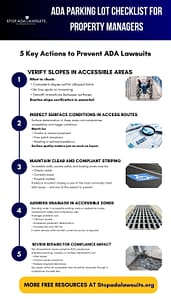
This checklist outlines the key pavement-related items every property manager should monitor to reduce ADA exposure and maintain compliance.
1. Verify Slopes in Accessible Areas
Accessible parking stalls, access aisles, and loading zones must remain within strict slope limits.
In California, slopes may not exceed 2% in any direction.
Over time, asphalt naturally settles and shifts. Even surfaces that were originally compliant can drift out of tolerance without obvious visual signs.
What to check:
-
Consistent slopes within allowed limits
-
No low spots or crowning
-
Smooth transitions between surfaces
Routine slope verification is essential.
2. Inspect Surface Conditions in Access Routes
Accessible routes must be firm, stable, and slip-resistant.
Surface deterioration within these areas can compromise accessibility and trigger violations.
Watch for:
-
Cracks or uneven pavement
-
Poor patch transitions
-
Raveling or surface breakdown
Surface quality matters just as much as layout.
3. Maintain Clear and Compliant Striping
Striping is not cosmetic — it is enforceable.
Accessible stalls, access aisles, and loading zones must be:
-
Clearly visible
-
Correctly sized
-
Properly marked
Faded or incorrect striping is one of the most commonly cited ADA issues and one of the easiest to prevent.
4. Address Drainage in Accessible Zones
Standing water in accessible parking areas or pedestrian routes creates both safety and compliance concerns.
Drainage problems can:
-
Obstruct access
-
Accelerate pavement deterioration
-
Increase slip-and-fall risk
If water remains after rainfall, corrective action is needed.
5. Review Repairs for Compliance Impact
Not all repairs preserve ADA compliance.
Improper patching, overlays, or surface adjustments can:
-
Alter slopes
-
Create uneven transitions
-
Reduce required clearances
Any repair within an accessible area should be reviewed through a compliance-focused lens.
6. Schedule Routine ADA-Focused Inspections
ADA compliance is not permanent.
A brief, routine inspection can:
-
Identify early deviations
-
Prevent compounded issues
-
Reduce reactive corrections
-
Protect long-term budgets
Consistency is more effective than last-minute fixes.
Why This Checklist Matters
Most ADA violations are predictable and preventable.
Proactive monitoring costs a fraction of:
-
Legal fees
-
Emergency corrective work
-
Accelerated repair timelines
Staying ahead of small issues significantly reduces risk.
The We Love Paving Approach
At We Love Paving, ADA considerations are integrated into our pavement evaluations.
We help properties:
-
Identify early compliance risks
-
Maintain accessible surfaces correctly
-
Plan repairs that preserve compliance
-
Reduce exposure before complaints arise
Our goal is to make compliance routine — not reactive.
Stay Ahead of ADA Risk
ADA issues are easiest to resolve before they become formal complaints.
📩 Contact We Love Paving to review your parking lot and ensure your pavement supports accessibility, safety, and compliance.