When California businesses think about ADA compliance, they tend to focus on the obvious: parking stalls, ADA signs, ramps, restrooms.
But the most common (and most expensive) violations don’t happen there…
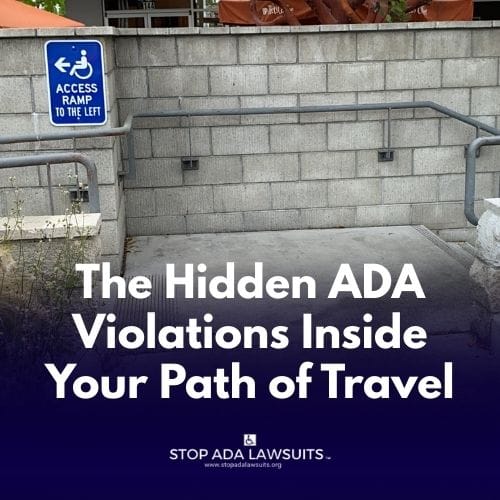
They happen in the Path of Travel — the continuous, unobstructed route from arrival points to all public areas of your business.
This is where serial ADA plaintiffs find easy wins, where inspectors find the highest number of infractions, and where owners lose $4,000–$20,000+ per lawsuit.
Today, we break down the hidden ADA violations inside your Path of Travel — the ones most business owners don’t even realize exist until it’s too late.
If you want to make sure your property passes upcoming ADA inspections, you can read a step-by-step guide on how to prepare your parking lot for ADA inspections here.
What Exactly Is the “Path of Travel”?
In ADA law, the Path of Travel is:
“A continuous route connecting all accessible elements of a site, including sidewalks, curb ramps, parking lots, entrances, hallways, restrooms, service counters, and public areas.”
If a customer can walk or roll through it, it must meet ADA standards.
The issue?
Most properties only fix “what looks ADA,” but ignore the subtle details that lawsuits target.
7 Hidden ADA Violations Inside Your Path of Travel
Below are the violations that show up in 8 of every 10 inspections we perform in California.
1. Slopes That Exceed 2% (Almost Invisible Unless Measured)
Most businesses assume their sidewalks and paths are “flat.”
But ADA requires:
-
Maximum cross slope: 2%
-
Maximum running slope: 5%
A sidewalk that feels flat can easily measure 3.5%, making it non-compliant and a lawsuit trigger.
Why it matters:
Wheelchair users drift sideways or roll backwards, creating a safety hazard.
2. Trip Hazards as Small as ¼ Inch
The ADA is extremely strict about vertical gaps:
-
¼” max without bevel
-
½” max with bevel
-
Anything higher = violation
Cracks, lifted panels, tree roots, uneven concrete — these are lawsuit magnets.
Why it matters:
Plaintiffs often photograph these as “dangerous conditions.” Courts take them seriously.
3. Missing or Incorrect “Transitions” Between Surfaces
Examples:
-
Asphalt to concrete
-
Sidewalk to ramp
-
Ramp to landing
-
Tile to vinyl
If the transition creates a bump over ½ inch, it’s a violation.
Most business owners never check this.
4. Door Entrances With Excessive Force or Wrong Hardware
Along the Path of Travel, every door must:
-
Require no more than 5 lbs of force
-
Use ADA-approved hardware (no knobs, tight pulls)
-
Have 32 inches clear width
-
Include proper landing space
Common hidden violation:
Doors get stiffer over time… owners don’t notice until they get sued.
5. Pathway Obstructions That Create Less Than 36 Inches of Clearance
ADA requires a minimum 36-inch clear path at all times.
Obstructions that cause violations:
-
Display racks
-
Patio furniture
-
Trash cans
-
Deliveries
-
Wall-mounted signs
-
Planters
Businesses change setups seasonally — and accidentally break ADA.
6. Curb Ramps That Look Fine But Fail Dimensionally
Most curb ramps fail not for looking wrong, but for dimensional violations, such as:
-
Slope over 8.33%
-
Missing 36″ landings
-
Side flares too steep
-
Missing detectable warning domes
-
Cross slope over 2%
-
Ramp width under 36″
A ramp can be brand new and still non-compliant if the contractor didn’t follow ADA specs.
7. The “Last Step” Problem: Restroom & Counter Access
Here’s the trap:
Even if the Path of Travel is 100% compliant,
if it leads to a non-compliant restroom or counter → you still fail ADA.
Common violations at the end of the Path:
-
Restroom door force too high
-
No 60″ turning radius
-
Counter over 36 inches
-
Missing knee/toe clearance
This is where lawsuits often multiply:
One violation leads to 10+ additional claims.
Why These Violations Matter in California (2026 Update)
California is the most litigious ADA state, with:
-
$4,000 minimum penalty per violation (Unruh Act)
-
Attorney fees on top
-
Serial plaintiffs filing 500–1,000+ lawsuits a year
The Path of Travel is the easiest place for these plaintiffs to find violations because:
-
Most issues are invisible to the untrained eye
-
They produce clear, undeniable photo evidence
-
They require expensive remediation
How to Fix Path of Travel Violations (Before Someone Else Finds Them)
1. Get a Professional ADA Site Inspection
A trained inspector checks:
-
Slopes
-
Distances
-
Clearances
-
Door pressures
-
Signage
-
Surface transitions
Most owners are shocked how many issues they didn’t see.
2. Prioritize the “High-Risk Zones”
We always fix these first:
-
Accessible parking
-
Sidewalks & ramps
-
Entrances
-
Restrooms
-
Service counters
These are the areas plaintiffs target most often.
3. Correct Violations to 2026 Standards
Codes change.
California is shifting toward stricter enforcement each year.
Fixes today prevent lawsuits tomorrow.
How StopADALawsuits Helps Business Owners
We specialize in:
-
ADA inspections
-
Path of Travel evaluations
-
CASp-guided reports
-
Concrete/asphalt ADA corrections
-
Risk mitigation
-
Full ADA compliance plans
Our goal:
Protect you from lawsuits before they happen — and make your property fully accessible for all.
Need Help? Get a Path of Travel ADA Review
Most violations inside your Path of Travel are invisible…
until a lawyer points them out.
Let us find and fix them before someone sues.
👉 Schedule a Free ADA Compliance Review
(Available for California business owners.)